In short
False alarms mostly come from seven causes: a pet, sun or heating in the sensor’s field of view, a window left open, a forgotten code, a battery running low, an insect on the sensor and a door rattling in the wind. Nearly all of them can be fixed with placement and habits: the motion sensor at a height of 2,1 m, a code for each family member and an eye on battery levels in the app. A sensor with a camera sends photos when the alarm goes off, so you see straight away whether the alarm is real.
- The motion sensor is pet-friendly up to 30 kg, at a height of 2,1 m
- Night mode: doors and windows armed, you move freely indoors
- Self-monitored system: a false alarm doesn’t trigger a patrol call-out
A false alarm gives you a fright, and after a couple of them it starts to get annoying. The worst part is that after several false alarms, people stop taking the alerts seriously, and that’s exactly when a real one may come. The indoor siren is 110 dB, so a false alarm at night wakes the neighbours too. The cause of a false alarm can almost always be found, and it’s usually not the sensor’s fault. Below are the seven most common causes and how to fix them.
Why do false alarms happen? The 7 most common causes
- A pet. The motion sensor is pet-friendly up to 30 kg, but only if it’s at a height of 2,1 m and the cat’s favourite spots (the top of a cupboard, the windowsill) are out of its field of view. If the cat climbs onto a shelf right in front of the sensor, the sensor takes it for a person. The fix is the right height and angle. Read more in the article where to put a motion sensor so the cat doesn’t set off the alarm.
- Sun and heating. A motion sensor reacts to changes in heat. A window where the evening sun shines in, or a radiator with warm air rising above it, can create “movement” in an empty room. If the false alarm comes every day at about the same time, this is usually the reason. The fix: point the sensor towards the door, so the window and heater are behind it or to the side.
- A window or door was left open. You armed the system, but the bedroom window is tilted open or the balcony door isn’t quite shut. The door sensor raises the alarm the moment the door or window moves. The fix: check the windows once before arming, especially in summer and during the heating season, when you air the place more often.
- A forgotten code. The neighbour came to water the plants, the cleaner is new or a child can’t remember the numbers. The door opens, the siren goes off and an alarm comes to everyone’s phone. The fix: give each person their own code or tag and show them the keypad in advance. For children and elderly people, a 4-button key fob is often easier than a code.
- A battery running low. The sensors run on batteries. A sensor with a weak battery isn’t reliable and can send alerts whose cause is hard to find. The fix: the app shows the battery level of every sensor. Check it a couple of times a year and change the battery before it runs completely flat.
- An insect on the sensor. A spider crawling right across the motion sensor’s lens looks big and close to the sensor. It happens more often in autumn, when insects look for a way indoors. The fix: wipe the sensor with a dry cloth now and then, and make sure there are no cobwebs around it.
- Wind on a door. An unlocked patio or sauna door that rattles in the wind can shift the gap between the magnet and the sensor enough for the door sensor to raise the alarm. The fix: lock or bolt the door. If it still moves, ask a technician to reposition the sensor and magnet.
| Cause | Which sensor | Quick fix |
|---|---|---|
| Pet | motion sensor | at a height of 2,1 m, the cat’s high spots out of view |
| Sun, heating | motion sensor | window and radiator behind the sensor |
| Open window | door sensor | check the windows before arming |
| Forgotten code | door sensor, keypad | everyone gets their own code, tag or key fob |
| Battery running low | any | battery level in the app |
| Insect | motion sensor | wipe the sensor with a dry cloth |
| Wind | door sensor | lock or bolt the door |
How does a sensor with a camera help you check a false alarm?
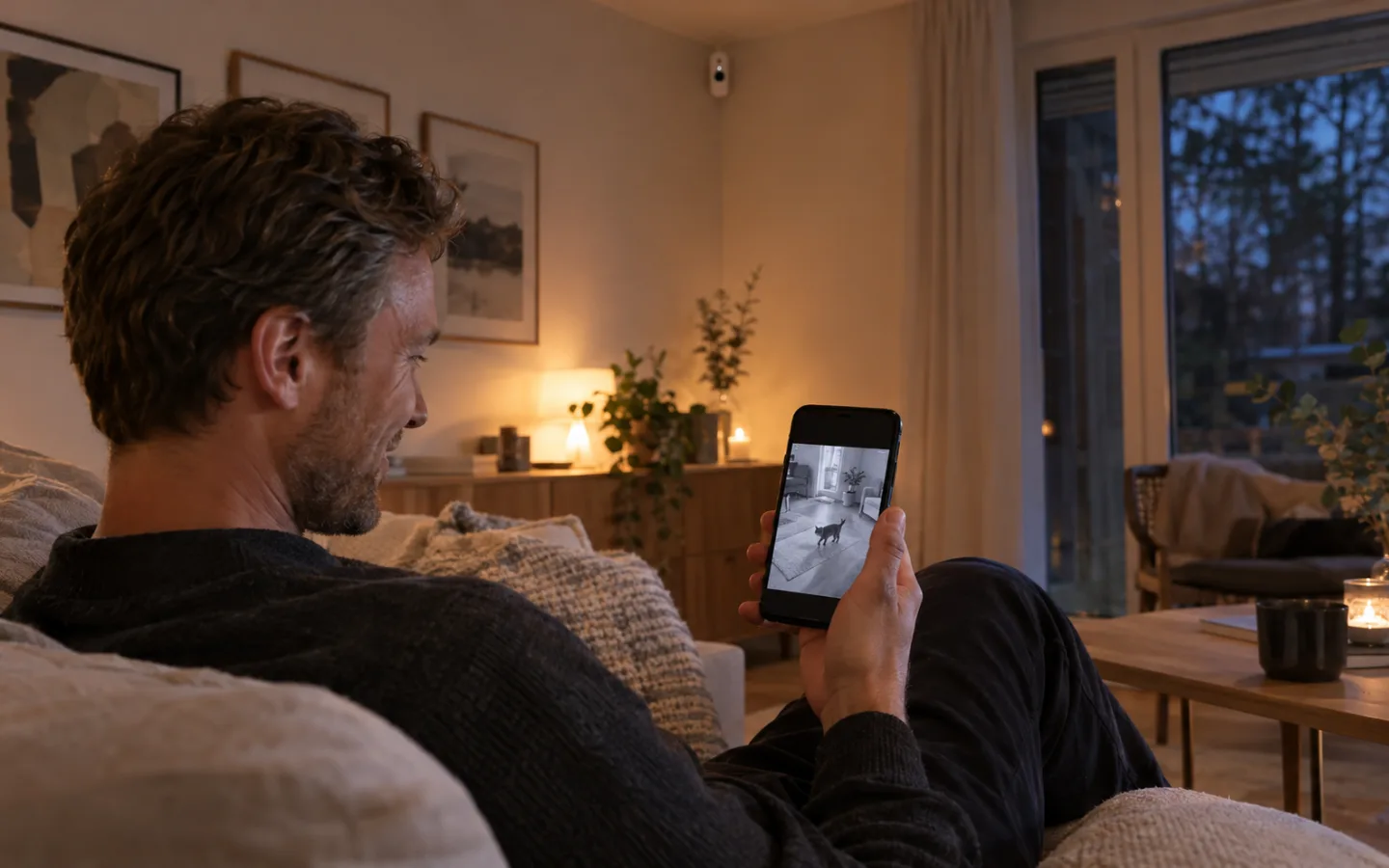
A standard sensor only tells you that something moved. The motion sensor with camera (75 € or 1,86 €/month) sends a series of photos to your phone when the alarm goes off, even in the dark. If the alarm comes in the middle of a working day, you open the photos and see straight away: the dog on the sofa, a patch of sunlight on the wall or a stranger in the hallway.
If the photo shows the cat, you re-arm the system from your phone and get on with your work. If it shows a person, you call 112 or ask a neighbour to check. No continuous video is recorded: the sensor only takes pictures when the alarm goes off. Bear in mind that the sensor with a camera isn’t pet-friendly in the same way as a standard motion sensor, so put it in the hallway or somewhere your pet can’t get to.
Tip. If a false alarm keeps happening, check three things in the app: which sensor, what time and whether it happens repeatedly. The same sensor at the same time usually points to sun or heating. If it’s a different sensor and a different time each time, look instead for an open window or someone who doesn’t know the code.
How does night mode reduce false alarms?
Lots of night-time false alarms happen simply because someone went to the kitchen for a glass of water. When the whole system is armed, the motion sensor sees you too. In night mode, the doors, windows and outdoor sensors stay armed, but you can move freely indoors. If someone opens the front door at night, the alarm goes off as usual.
You can switch on night mode from the keypad, your phone or the key fob, which has a separate button for it. The key fob has 4 buttons: arm, disarm, night mode and panic. If your pet wanders around at night, night mode is the simplest solution for them too.
Does a false alarm cost anything?
The GSMvalve system is self-monitored: the alarm goes to your phone and the phones of other added users, not to a monitoring centre. GSMvalve is not a security company and doesn’t send anyone out. So a false alarm doesn’t trigger a patrol call-out or a bill for one. A false alarm still disturbs you and your neighbours, though, because the siren is 110 dB.
It’s different if you have added a patrol through a partner. A patrol is a separate service and its price depends on the area, so ask before you sign up how a call-out to a false alarm is charged. The same goes for a security company’s monitoring service: there, a patrol comes out when the alarm goes off, and the terms for false alarms are set out in the contract. If you want someone to always come out, a security company contract is the right choice, but then it’s even more worth paying attention to avoiding false alarms.
What should you do if false alarms keep happening?
Start with the history in the app: it lists every alarm with the sensor’s name and the time. If the cause is placement, the sensor can be moved somewhere else. If the sensor is faulty, a technician replaces it by the price list. A device you bought comes with a 2-year right to claim, and after that a technician call-out costs from 35,20 € (including 0,5 hours of work). If you can’t track down the cause yourself, write to us, and we’ll reply within 1 working day.
Summary
Most false alarms disappear with three steps: the motion sensor at a height of 2,1 m and pointing towards the door, a code for each family member and night mode at night. Put a sensor with a camera in the hallway, and with every alarm you can see from a photo whether there’s any reason to worry. Check battery levels in the app a couple of times a year, and go round the windows before you arm the system.
Frequently asked questions
What is the most common cause of a false alarm?
Most false alarms come from a motion sensor at the wrong height or angle: there’s a window, a radiator or a spot the cat climbs onto in its field of view. The GSMvalve motion sensor is pet-friendly up to 30 kg when it’s installed at a height of 2,1 m and points towards the door.
Do I have to pay for a false alarm?
With GSMvalve, the alarm goes to the phones of the owner and added users and nobody is sent out, so there’s no charge for a false alarm. If you have added a patrol through a partner, the call-out terms and price depend on the partner and the area.
How can I check whether an alarm is real?
The motion sensor with camera sends a series of photos to your phone when the alarm goes off, even in the dark, so you see straight away whether it’s a person, an animal or a patch of sunlight. The app also shows which sensor raised the alarm and when.
What is an alarm system’s night mode?
In night mode, the doors, windows and outdoor sensors stay armed, but you can move freely indoors. You can switch on night mode from the keypad, your phone or with a separate button on the key fob.
Read also: motion sensors and pets · the sensor with a camera on the devices page · what the app shows
Written by the GSMvalve team
Still have questions?